When it comes to stopping power, not all brake pads are created equal. For medium duty truck operators — whether you’re running a Class 4–6 fleet, a work truck, or a vocational vehicle — choosing the right brake pad compound can affect safety, maintenance costs, driver experience, and long-term rotor life. It’s a decision that gets made at every service interval, and getting it wrong costs money.
Understanding the Compounds
Before comparing performance, it helps to understand what these pads are actually made of.
Semi-Metallic Brake Pads contain anywhere from 30% to 65% metal by weight — typically a blend of steel wool, iron powder, copper fibers, and graphite, all bound together with resin. The high metal content is what gives them their characteristic aggressive bite and durability. They’ve been the dominant choice in commercial and heavy-duty applications for decades, and for good reason: they were engineered to handle serious work.
Ceramic Brake Pads use dense ceramic fibers, bonding agents, and small amounts of non-ferrous filler (such as copper or aramid fiber) to create a compound that’s harder and more consistent than organic pads, but far less abrasive than metallic. Ceramic technology was originally developed for passenger vehicles in the 1980s, but formulations have steadily improved and migrated into light and medium duty truck territory.
There’s also a third category worth mentioning — organic (non-asbestos organic, or NAO) pads — but these are soft, wear quickly under load, and are generally not appropriate for medium duty applications. We’ll set them aside for this comparison.
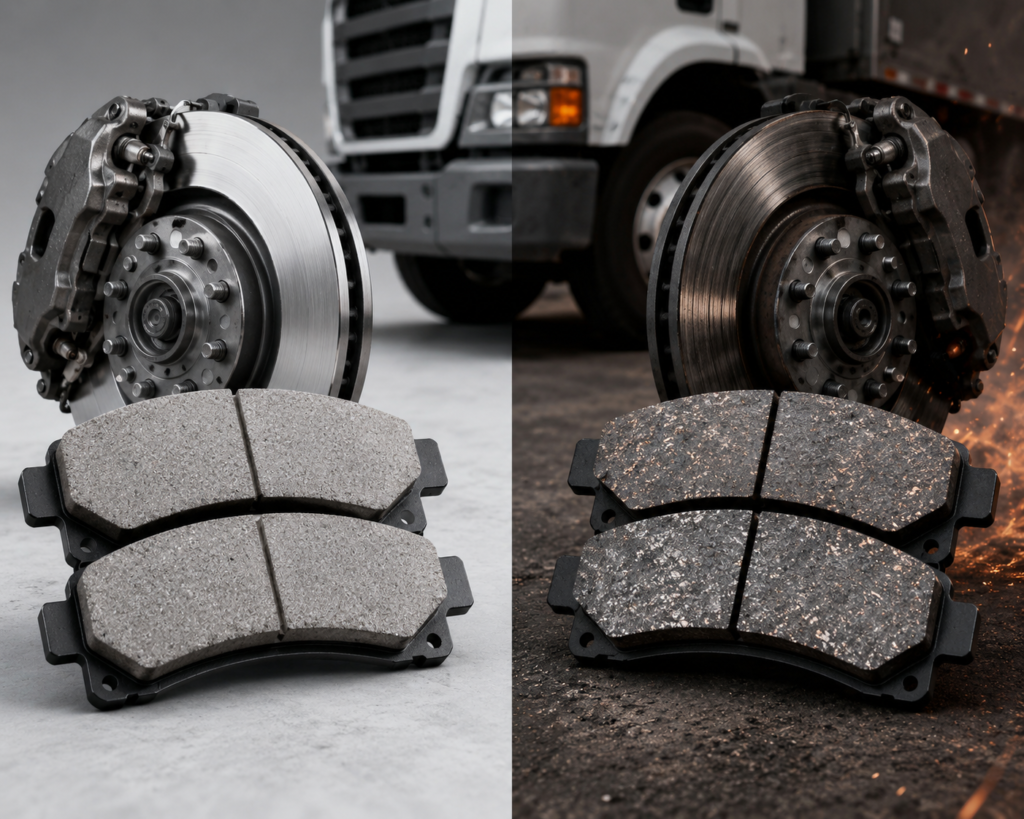
What’s the Difference?
Metallic (Semi-Metallic) Brake Pads are made from a blend of metals — typically steel wool, iron powder, copper, and graphite — bound together with resin. They’ve been the industry standard for heavy-duty applications for decades.
Ceramic Brake Pads use ceramic fibers and bonding agents with small amounts of copper or non-ferrous filler. Originally developed for passenger cars, ceramic formulations have expanded into light and medium duty truck applications.
Performance Comparison
Stopping Power
Semi metallic pads generally deliver stronger bite, especially under high-load or repeated heavy braking — the kind of stress a medium duty truck sees daily. Ceramic pads offer consistent, predictable stopping but typically can’t match metallic compounds at the thermal extremes that commercial hauling creates.
Edge: Metallic
Heat Tolerance
Semi-metallic pads absorb and dissipate heat effectively, making them well-suited for trucks that brake frequently — delivery routes, mountain grades, stop-and-go urban hauling. Ceramic pads handle moderate heat well but can fade under sustained high-temperature braking.
Edge: Metallic
Rotor Wear
This is where ceramics gain ground. Ceramic compounds are significantly less abrasive than metallic pads, extending rotor life. On a medium duty truck where rotors aren’t cheap, this can matter to the bottom line.
Edge: Ceramic
Dust and Mess
Semi metallic pads produce dark, metallic dust that coats wheels and brake components. Ceramic pads produce far less dust, and what they do produce is lighter in color. For fleets with clean appearance standards or frequent wash schedules, this adds up.
Edge: Ceramic
Noise
Semi-metallic pads are noisier — squealing and grinding under cold starts or light application is common. Ceramic pads run quieter in most operating conditions.
Edge: Ceramic
Cold Weather Performance
Semi-metallic pads bite well even when cold, which matters for trucks operating in northern climates or making early morning starts. Ceramic pads can feel soft until they reach operating temperature.
Edge: Metallic
Cost
Ceramic pads typically cost more upfront. However, the reduced rotor wear can offset this over time depending on your application.
Edge: Metallic (upfront) / Ceramic (long-term, light-duty cycles)
The Bottom Line
For most medium duty truck applications — where load, heat, and cycle frequency are elevated — semi-metallic pads remain the go-to choice. They’re proven, widely available, and built for the conditions commercial trucks actually face.
Ceramic pads have a place in medium duty: lighter cycle applications, fleets prioritizing clean wheels and rotor longevity, or mixed-use trucks that don’t see sustained heavy braking. But running ceramics on a workhorse that hauls daily is leaving stopping performance on the table.
When in doubt, match the pad to the job — not the price tag.
Need help finding the right brake pads for your Class 4–6 truck? Browse our medium duty brake catalog or contact our parts team for application-specific recommendations.