
Your brake chambers are one of the most critical safety components on your medium-duty truck. These air-actuated devices convert air pressure into the mechanical force that stops your vehicle. When they start to fail, the consequences can range from reduced stopping power to complete brake loss — putting you, your cargo, and everyone on the road at risk.
Here are the key warning signs to watch for.
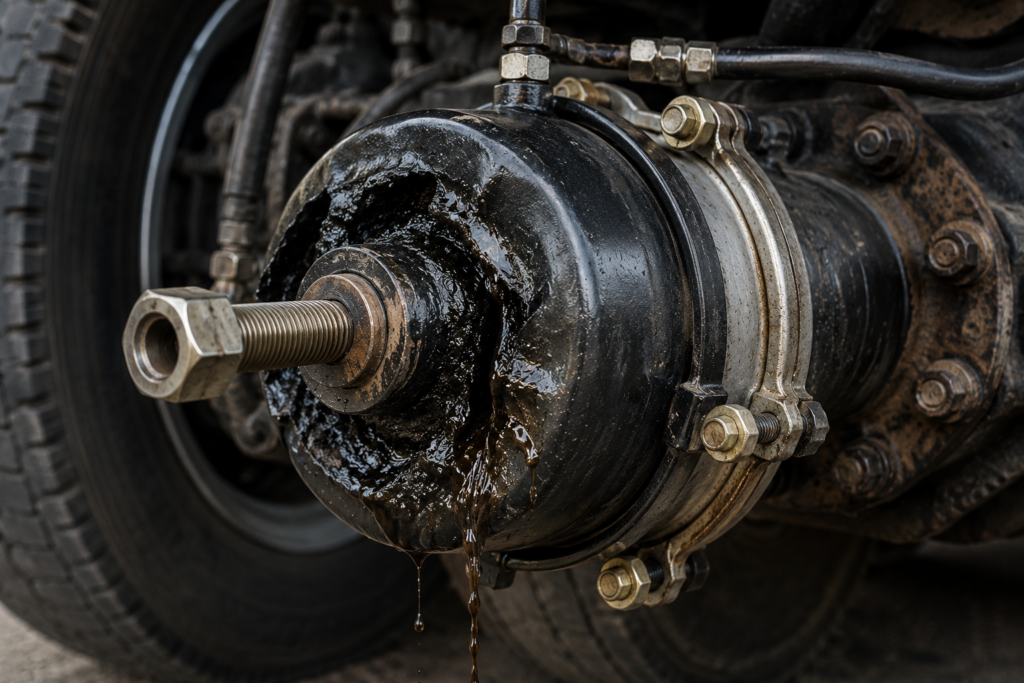
1. Longer Stopping Distances
If your truck is taking noticeably longer to stop than usual, a weakening brake chamber is often the culprit. As the diaphragm inside the chamber ages and deteriorates, it loses its ability to generate full actuation force at the pushrod. You may feel like you’re pressing harder on the pedal for less response. Don’t dismiss this as “normal wear” — it’s your truck telling you something is wrong.
2. Hissing or Audible Air Leaks
Brake chambers rely on an airtight diaphragm to hold pressure. When the diaphragm cracks or tears, air escapes — and you’ll hear it. A hissing sound near a wheel well, especially when the brakes are applied or released, almost always points to a compromised chamber. On a loaded truck, even a small air leak can mean dangerously slow brake response.
A quick roadside check: apply the brakes and hold them, then walk the truck. Any audible hiss coming from a chamber location is a red flag.
3. Uneven Braking or Pulling to One Side
If your truck pulls left or right when braking, one side’s brake chamber may be delivering less force than the other. This imbalance can indicate a failing diaphragm on the weak side, or a pushrod that’s no longer stroking correctly. Beyond being uncomfortable to drive, pulling under braking creates serious instability — especially at highway speeds or when loaded.
4. Pushrod Out-of-Spec Stroke
Brake chambers are designed to operate within a specific pushrod stroke range. Most jurisdictions use CVSA out-of-adjustment standards to define the limit. If your pushrod is consistently at or beyond its maximum stroke even after adjustment, the chamber internals may be worn or deformed. A quick stroke check with a ruler at the time of your pre-trip is one of the easiest ways to catch this early.
5. Visible Rust, Corrosion, or Physical Damage
Canadian road conditions — road salt, freeze-thaw cycles, and gravel spray — are brutal on brake chambers. Inspect the chamber housing and clamp band regularly. Surface rust is normal, but deep corrosion, cracks around the clamp, or a deformed housing means the chamber is compromised structurally. A chamber that looks bad often acts bad too.
6. Failed Air Pressure Build-Up
If your system is taking longer to reach operating pressure, or the low-pressure warning light is cycling on during operation, a leaking brake chamber could be the source. This is especially dangerous because it affects your entire brake system, not just one wheel.
Don’t Wait to Replace a Bad Chamber
Brake chambers are a maintenance item — not an emergency-only replacement. For Hino and Isuzu medium-duty trucks, chambers are relatively straightforward to replace when you have the right part on hand. Running on a failing chamber puts you at risk of a DOT inspection failure, a roadside OOS order, or worse.
At MediumDutyTruckParts.com, we stock brake chambers for Hino 145, 165, 195, 238, 258, 268 and Isuzu NPR, NQR, NRR, FTR, and FVR applications — shipped fast across Canada via UPS and Purolator.
Have questions about which chamber fits your truck? Contact us at support@mdtruckparts.com or use our fitment search to find the right part.