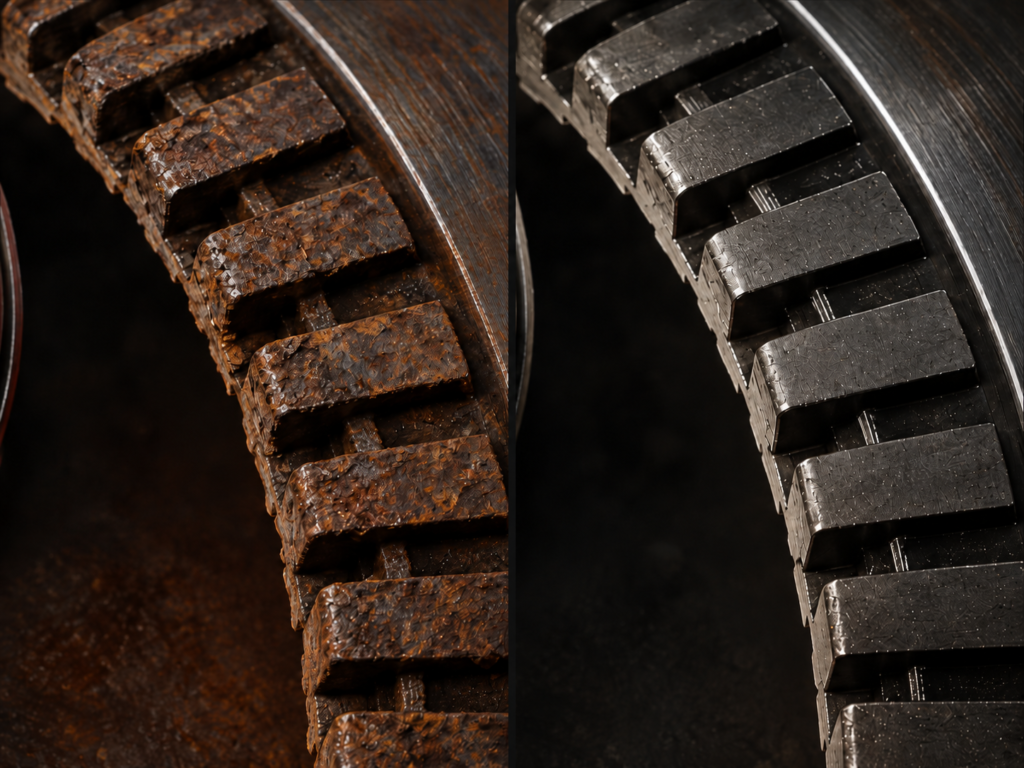
A truck comes back from a week parked outside and the rotors are orange. Every operator has seen it, and every operator has had the same argument with someone in the shop about whether it matters. Most of the time it doesn’t. Sometimes it means the rotor is finished, and once in a while it means something that will fail a safety inspection even after you fit new rotors.
Here is how to tell the three apart on a medium duty truck, and what to check before you order anything.
Surface rust is not a problem. Pitting is.
Bare cast iron flash-rusts in hours. Park a truck in the rain on Friday and the swept face of every rotor will be brown by Monday. That film is microns thick, it sits only where the pad isn’t clamped, and the first half-dozen stops scrub it off. If the rotor is clean and even after a short drive, nothing happened.
The rust that ends a rotor is the kind that had time to eat into the metal. It shows up on trucks that sat for a season, not a weekend — spare units, seasonal equipment, anything that came off the road in November and is being woken up in April. The tell is that driving doesn’t clean it: after a few kilometres the swept path is shiny in places and still dark and rough in others. Those dark patches are pits, and the pad is now riding across a surface with holes in it. You will feel it as a pulse through the pedal and hear it as a rhythmic scrape once per wheel revolution.
The distinction in one line: rust that wipes off is dirt, rust that stays is missing metal.
Measure it. Don’t eyeball it.
A pitted rotor can look salvageable and still be below spec, because the corrosion removed material before you ever touched it with a lathe. Two numbers decide the job, and neither of them is a judgement call:
- Minimum thickness (discard thickness). It is cast or stamped into the rotor hat on virtually every medium duty rotor. Find it and measure the thinnest point of the swept area with a micrometer, not a caliper on the edge — the edge keeps its original thickness and will lie to you.
- Lateral runout. Dial indicator on the face, rotate one full turn. Corrosion under the hub mounting face is a common cause of runout that shows up as a pulse the day after a brake job, and it has nothing to do with the rotor itself.
If the measured thickness is at or under the discard figure, the rotor is scrap — machining it is not an option, because machining only removes more. If it is above spec but the pitting is deep enough to catch a fingernail across the swept path, the useful question is whether enough material remains to clean up and still stay above minimum after wear. Usually it doesn’t.
We deliberately don’t publish minimum thickness figures by model. They are safety-critical, they differ between front and rear and between production years on the same nameplate, and the authoritative number is the one on your rotor or in the OE service data — not on a parts website.
Rust jacking and the caliper that never let go
Two failures travel with heavy corrosion and both get blamed on the rotor. (A third, unrelated to the rotor but often found in the same inspection, is a failing brake chamber.)
Rust jacking happens under the friction material, not on the rotor. Moisture gets between the pad’s backing plate and the friction block, the corrosion expands, and it lifts and cracks the friction material off the plate. You’ll find chunks missing from a pad that still has plenty of material left. If you are pulling rusted rotors off a truck that sat, inspect the pads off the vehicle — a delaminating pad on a new rotor will destroy it.
A seized caliper leaves the signature that makes a rusty-rotor call easy: one rotor on the axle is clean and polished while the other is still dark. The clean one is being dragged constantly; the dark one isn’t being clamped at all. Replacing rotors without fixing that guarantees a repeat.
The part most people miss: the ABS tone ring
This is the one that turns a routine brake job into a comeback.
On most medium duty trucks the ABS tone ring sits on or immediately against the rotor, in the same wet, salted environment. It is a toothed ring, and the ABS sensor reads the gaps between those teeth. Corrosion doesn’t have to destroy it to break it — rust building up in the tooth gaps is enough to distort the signal, and rust expanding under a cast-in ring cracks it outright.
What you get is an ABS fault light with no obvious mechanical problem, on a truck whose brakes feel fine. It is also an inspection failure, which is why it tends to be discovered at the worst possible moment.
Worth knowing before you start the job:
- If the truck has an ABS light and corroded rotors, check the tone ring while everything is apart. Access is never cheaper than right now.
- A tone ring that is cast into the rotor during manufacturing has a porous structure that traps moisture. A ring precision-milled after casting and given an anti-corrosion coating holds up considerably longer in salt — this is the single biggest difference between rotors that look identical in a catalogue.
- Sensor and ring are separate parts and separate failures. A clean ring with a dirty or damaged sensor reads just as badly.
We stock tone rings and ABS wheel speed sensors for Hino, Isuzu, Freightliner, Kenworth, GMC and Mitsubishi Fuso applications.
Road salt: what actually helps
You cannot coat your way out of a brake rotor problem — the swept face has to stay bare metal, and anything you spray on it either burns off or ruins the friction. What is worth doing on salt-belt trucks:
- Wash the underside, not just the body. Salt sitting in the hub and around the tone ring does the damage you can’t see.
- Don’t park a truck wet after a wash. A few stops before it sits dries the rotors and leaves far less to corrode.
- Move seasonal units. Ten minutes a month is the difference between flash rust and pitting.
- Buy the coating where it belongs. On the hat, the vanes and the tone ring — every surface except the friction face. That is what separates a rotor that survives three winters from one that doesn’t.
When you are replacing: match the rotor, not just the truck
Medium duty rotors are not interchangeable across a nameplate. The same model can take a different rotor front to rear, across production years, and between chassis variants — hat height, bolt hole count, caliper piston count and whether the rotor carries ABS holes all change the part number.
A few real examples from our catalogue to show how tight it gets:
| Part | Application | Position |
|---|---|---|
| 13-20896 / 13-20897 | Hino 195 (2012–2020), Hino M5 (2021–2022) | Front / Rear |
| 13-20898 / 13-20899 | Hino 155 (2012–2020), Hino M4 (2021–2022) | Front / Rear |
| GB31462 / GB31461 | Hino 185 (2005–2010) | Front / Rear |
| GB123557 | Hino 238 (2015–2020) front; Hino 238 (2005–2014) and 258 (2006–2020) rear | Front / Rear |
| 13-21230 | Hino S5 (2023–2024) | Front |
| BR31296 | Hino S4 (2023–2024) | Front |
Note the third row: on the 238, the same casting is a front rotor on later trucks and a rear rotor on earlier ones. Ordering by model name alone is how the wrong part ends up on the bench.
Our disc brake rotor range covers International, Hino, Freightliner, Chevrolet, Ford, GMC, Isuzu, IC Corporation, Kenworth, Peterbilt, Blue Bird, Thomas, Mitsubishi Fuso, Sterling, Dodge and Ram applications. If you’d rather work from the truck, start with Hino (the 268 and 258 carry the most parts) or Isuzu and narrow by model, or use the year/make/model selector on any product page to confirm fitment before you order.
The short version
- Rust that wipes off after a few stops is normal. Rust that survives a drive is pitting.
- The decision is a measurement — discard thickness off the rotor hat, plus runout — not a look.
- Check the pads for rust jacking and the axle for one polished rotor and one dark one before you blame the rotors.
- If there’s an ABS light, inspect the tone ring while the hub is apart.
- Confirm front vs rear and the production year before ordering. On several Hino models the same casting changes position between years.
Not sure which rotor your truck takes? Use the fitment selector on any product page — enter year, make and model and it will tell you whether that exact part fits before you buy.